
Iron deficiency affects more than 1.5 billion people worldwide, making it the most common and yet preventable nutritional deficiency. Without enough iron, your body struggles to make healthy red blood cells, starving your organs of oxygen. The results? Unrelenting tiredness, pale skin, shortness of breath, brain fog, and weakened immunity, everyday life grinds to a halt. This deep-dive guide unpacks everything about iron deficiency: what it is, why it matters, how to spot it, the best ways to treat it, and crucially, how to prevent it for yourself and your family.
What Is Iron Deficiency?
Iron deficiency means your body doesn’t have enough iron to function optimally. This condition is not the same as anemia, though prolonged iron deficiency often leads to iron deficiency anemia, where red blood cell (RBC) numbers drop below normal.
Iron’s role:
- Vital for hemoglobin synthesis (in RBCs)
- Essential for oxygen delivery to tissues
- Supports energy production and immune system function
Difference between Iron Deficiency and Anemia:
- Iron deficiency: Low iron stores but possibly still normal RBC counts/hemoglobin.
- Iron deficiency anemia (IDA): Iron stores are depleted AND RBC production is impaired, a more severe condition with greater health risks.

Why Does Iron Deficiency Matter? (The Global Perspective)
Prevalence: Over 30% of the world’s population experiences iron deficiency. Learn more through WHO data.
Impact: Children, women of reproductive age, and pregnant women are most affected.
Consequences:
- Reduced productivity and school performance
- Delayed cognitive/motor development in children
- Weakened immunity
- Increased maternal and infant mortality
Iron deficiency can remain “silent” for months, by the time symptoms become obvious, your health may already be at risk.
What Causes Iron Deficiency?

The Four Pillars of Iron Deficiency Causes
| Cause | Who’s Most at Risk | How It Happens |
|---|---|---|
| Poor Dietary Intake | Vegans, vegetarians, elderly | Low intake of heme iron (from animals) and vitamin C |
| Blood Loss | Women (menstruation); GI disease | Heavy periods, ulcers, hemorrhoids, GI cancer, IBD |
| Increased Needs | Pregnancy, kids, teens, athletes | Rapid growth, pregnancy, lactation, physical training |
| Absorption Problems | Celiac, post-bariatric surgery | Damaged gut lining, low stomach acid |
Additional factors:
- Parasitic infections (developing regions)
- Frequent blood donations
- Use of certain medications (e.g. NSAIDs causing GI bleeding)
Symptoms of Iron Deficiency
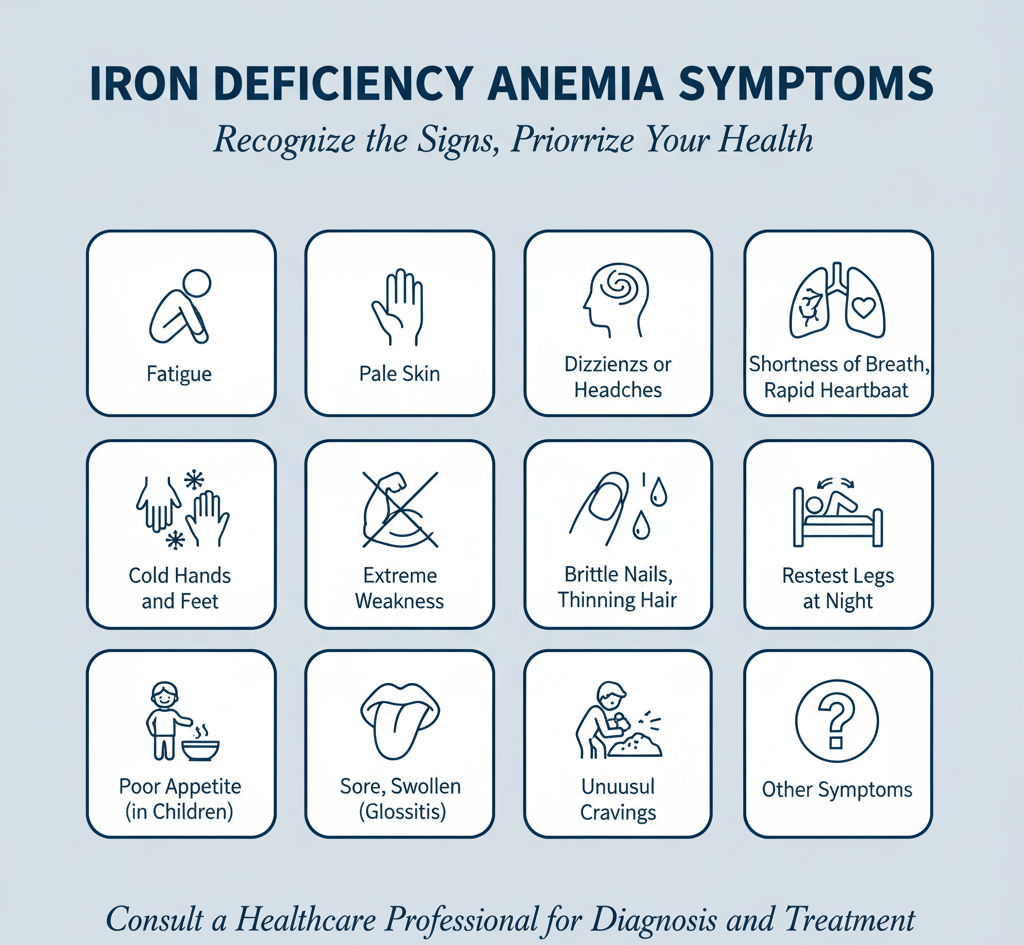
Fatigue (most common, often dismissed as “busy life”)
Iron is essential for producing hemoglobin, which carries oxygen to tissues. Without enough iron, your body can't deliver sufficient oxygen to muscles and organs, causing overwhelming tiredness even with adequate rest. Many people mistake this for stress or being overworked.
Pale skin (especially around lips, inside lower eyelids)
Hemoglobin gives blood its red color. Low iron means less hemoglobin, causing blood to become less red. This shows most noticeably in areas with thin skin or visible blood vessels the inner eyelids, lips, nail beds, and face appear washed out or grayish.
Shortness of breath, rapid heartbeat (even with light activity)
With reduced oxygen-carrying capacity, your heart must work harder and beat faster to deliver enough oxygen throughout your body. Simple tasks like climbing stairs become exhausting because your cardiovascular system is compensating for oxygen deficiency.
Dizziness or headaches
Insufficient oxygen reaching the brain causes lightheadedness and frequent headaches. The brain is extremely sensitive to oxygen deprivation, making these symptoms appear early in iron deficiency.
Cold hands and feet
Poor oxygen delivery affects circulation to extremities first. Your body prioritizes vital organs, leaving hands and feet feeling perpetually cold even in warm environments.
Extreme weakness, poor exercise tolerance
Muscles need oxygen to function efficiently. Without adequate iron, muscle cells can't generate energy properly, leading to weakness and rapid fatigue during physical activity.
Brittle nails, thinning hair
Hair follicles and nail beds require constant cell renewal, which demands oxygen and nutrients. Iron deficiency slows this process, causing nails to become brittle, ridged, or spoon-shaped (koilonychia), while hair becomes thin, dry, and falls out more easily.
Restless legs at night
Iron deficiency is one of the most common causes of restless leg syndrome (RLS). Low iron affects dopamine production in the brain, causing uncomfortable sensations and an irresistible urge to move legs, especially when trying to sleep.
Sore, swollen tongue (glossitis)
The tongue's surface may become smooth, pale, and inflamed. Taste buds can flatten, making the tongue appear glossy and causing pain or burning sensations, especially when eating acidic or spicy foods.
Unusual cravings: ice, clay, dirt (pica)
Pica is a compulsive craving for non-food items. Ice craving (pagophagia) is particularly common in iron deficiency some researchers theorize that chewing ice may temporarily increase blood flow to the brain, providing relief. Clay or dirt cravings (geophagia) may represent the body's misguided attempt to obtain minerals. Pica is a significant warning sign requiring medical attention, as consuming non-food items can cause poisoning, infections, intestinal blockages, and dental damage.
Poor appetite (in children)
Iron-deficient children often show reduced interest in food, creating a vicious cycle where decreased eating worsens the deficiency. This can significantly impact growth and cognitive development if left untreated.
Important Note: These symptoms develop gradually as iron stores deplete. Multiple symptoms occurring together strongly suggest iron deficiency anemia and warrant blood testing (complete blood count and ferritin levels) and medical evaluation.
How Is Iron Deficiency Diagnosed?

Correct diagnosis means more than a simple hemoglobin test. Your doctor will:
Clinical History: Symptoms, dietary patterns, medical history, menstrual/bleeding history.
Physical Exam: Look for pallor, rapid pulse, brittle nails, mouth/tongue changes.
Blood Tests:
- CBC (Complete Blood Count): Checks hemoglobin, hematocrit, red cell count (anemia indication)
- Serum Ferritin: Best early test (reflects iron stores; low even before anemia develops)
- Serum Iron, TIBC, Transferrin Saturation: Measures circulating iron, iron-binding capacity in the blood
- Reticulocyte count: Shows if the body is making new blood cells
If needed:
- Stool tests for occult blood (to check GI bleeding)
- Endoscopy/Colonoscopy (if GI source suspected)
Iron Deficiency Treatments That Work
1. Iron Supplements (First Line)
- Ferrous sulfate: Standard and affordable
- Ferrous gluconate/fumarate: Gentler on stomach; useful if sensitive to standard tablets
- Slow-release iron: Lower GI irritation
- IV iron transfusions: For severe cases or if pills are not tolerated
- Combined with vitamin C: Boosts absorption
How to take:
- Best on empty stomach but can take with food to reduce stomach upset
- Avoid tea, coffee, dairy at the same time (reduce absorption)
2. Iron-Rich Diet
| Food (100g) | Iron Type | Iron Content | How to Boost Absorption |
|---|---|---|---|
| Beef liver | Heme | 6.5 mg | Pair with veggies/fruit |
| Red meat (lean) | Heme | 2.7 mg | |
| Chicken/turkey | Heme | 1.3 mg | |
| Lentils (cooked) | Non-heme | 3.3 mg | Add lemon juice |
| Tofu | Non-heme | 2.7 mg | Serve with peppers |
| Spinach (cooked) | Non-heme | 3.6 mg | Combine with citrus |
| Fortified cereals | Non-heme | Up to 18 mg | Use non-dairy milk, OJ |
| Clams, oysters | Heme | 7 to 28 mg |
3. Treat the Underlying Cause
- Stop hidden bleeding: (e.g., treat ulcers, polyps)
- Correct absorption issues: Manage celiac, inflammatory bowel, treat infections
- Address periods: Discuss medical options for very heavy menstrual bleeding
For more on iron in foods, visit USDA FoodData Central.
Iron Deficiency in Special Groups
Women (Menstruation, Pregnancy, Lactation)
- More frequent iron loss due to periods
- Doubled/tripled needs during pregnancy (fetal growth, placenta, blood volume)
- Postpartum needs during breastfeeding
Children & Teens
- Growth spurts raise iron demands
- Risk of developmental delay with long-term deficiency
- Picky eating = dietary gaps
Elderly
- Often less dietary meat intake
- Gut absorption less efficient
- More likely to have chronic blood losses or GI problems
Athletes
- Sweat and microbleeds raise loss
- Female athletes especially at risk
Prevention Tips: Stop Iron Deficiency Before It Starts
- Eat diverse, iron-rich foods: include animal and plant sources
- Always pair non-heme (plant) iron with vitamin C foods for best absorption
- Use cast iron cookware (boosts iron in food, especially with acidic foods)
- Timing matters: Take coffee/tea or calcium supplements between meals, not with them
- Take regular dietary supplements if pregnant, menstruating heavily, or at other high risk (ask your doctor)
- Ensure infants and toddlers, kids, teens get iron-fortified foods and regular checkups
- Routinely check iron status if you’re at risk
When to See a Doctor for Iron Deficiency
Urgent situations:
- Persistent extreme fatigue
- Rapid heart rate, palpitations, chest pain
- Shortness of breath with mild activity
- Paleness unresponsive to home remedies
- Symptoms don’t improve after supplements/food changes
At-risk groups (pregnant, kids, elderly, GI disease) should be extra proactive about screening and medical supervision.
Top Iron Deficiency Supplements of 2025
| Supplement Name | Best For | Type | Pros | Rating |
|---|---|---|---|---|
| Nature Made Iron 65mg | Beginners | Tablet | Good absorption, value | ★★★★☆ |
| Slow Fe Iron Tablets | Sensitive Stomachs | Slow-release | Gentler on GI tract | ★★★★☆ |
| MegaFood Blood Builder | Vegans/Natural Seekers | Whole-foods | Non-constipating | ★★★★☆ |
| Floradix Liquid Iron | Children & absorption | Liquid | Pleasant taste, kid-friendly | ★★★★☆ |
Conclusion: Take Charge of Your Iron Health
Iron deficiency is common, insidious, but completely treatable and preventable. If you recognize the symptoms, get tested, and take action, be it with food, supplements, or by treating underlying health problems, you can reclaim your energy, clarity, immunity, and quality of life.
- Eat smart, supplement wisely, and don’t ignore persistent signs.
- Screen regularly if you belong to higher-risk groups.
- You deserve healthy iron levels, and all the vitality that comes with them!
Frequently Asked Questions (FAQs)
Q1. What’s the fastest way to fix iron deficiency?
A: Prescription iron supplements (sometimes IV iron) plus improving your iron-rich diet and pairing with vitamin C. IV iron is fastest but only for severe cases.
Q2. How long does it take to recover from low iron?
A: 2 to 4 weeks for symptoms to improve; 3 to 6 months for full restoration of normal blood levels (ferritin/hemoglobin).
Q3. Can I fix iron deficiency naturally?
A: Mild deficiency may be reversed with iron-rich food plus vitamin C, but supplements are needed for most moderate/severe cases.
Q4. Who is most likely to get iron deficiency?
A: Women with heavy periods, pregnant women, young children, teens, those with GI problems/chronic conditions, and older adults.
Q5. What is the best iron supplement?
A: Ferrous sulfate is most studied; slow-release or alternative forms work better for sensitive stomachs. Always consult your doctor for the right type and dose.
Q6. What foods are best for iron?
A: Animal sources (heme iron) are best absorbed, red meat, poultry, seafood. For vegetarians, focus on lentils, beans, spinach, tofu, fortified cereals plus vitamin C foods.
Q7. What blocks iron absorption?
A: Coffee, tea, wine, calcium supplements, high-fiber raw bran, certain medications and avoid with main iron-rich meals.
Sources
- Pasricha, S.R., Tye-Din, J., Muckenthaler, M.U. and Swinkels, D.W., 2021. Iron deficiency. The Lancet, 397(10270), pp.233-248. Available At : Pasricha, S.R., Tye-Din, J., Muckenthaler, M.U. and Swinkels, D.W., 2021. Iron deficiency. The Lancet, 397(10270), pp.233-248.
- Camaschella, C., 2019. Iron deficiency. Blood, The Journal of the American Society of Hematology, 133(1), pp.30-39. Available At : https://ashpublications.org/blood/article/133/1/30/6613/Iron-deficiency
- Weissbluth, M., 1974. Hemoglobin. In Hemoglobin: Cooperativity and Electronic Properties (pp. 10-26). Berlin, Heidelberg: Springer Berlin Heidelberg. Available At : https://link.springer.com/chapter/10.1007/978-3-642-80801-2_2
- Schechter, A.N., 2008. Hemoglobin research and the origins of molecular medicine. Blood, The Journal of the American Society of Hematology, 112(10), pp.3927-3938. Available At : https://ashpublications.org/blood/article/112/10/3927/24585/Hemoglobin-research-and-the-origins-of-molecular
- Vieth, J.T. and Lane, D.R., 2014. Anemia. Emergency Medicine Clinics, 32(3), pp.613-628. Available At : https://www.emed.theclinics.com/article/S0733-8627(14)00031-5/abstract
- Dugdale, M., 2001. Anemia. Obstetrics and gynecology clinics of North America, 28(2), pp.363-382. Available At : https://www.sciencedirect.com/science/article/abs/pii/S0889854505702060
About the Author

Dr. Ervin Downing earned his Doctor of Medicine (MD) from University of Michigan Medical School and completed his residency in Internal Medicine at Mayo Clinic, where he built his expertise in chronic disease prevention and metabolic health. With over 16 years of clinical experience, he specializes in blood pressure support, blood sugar management, bladder health, and immune resilience. At Beauty Health Fitness Remedies, Dr. Downing reviews supplements related to cardiovascular wellness, nerve support, and long-term vitality. His medical background helps him evaluate ingredient safety, effectiveness, and long-term practicality. He is committed to helping readers make informed decisions through evidence-based supplement guidance.